The AI that plans your next build in 30 seconds.

Construction hasn't meaningfully changed in 200 years. We're the first company that made that a design problem — and solved it.

Validate the system

Send technical visitors to proof, specs, or review.

Technology interest usually means a visitor is trying to decide whether the system is credible enough for plans, code review, capital review, or a builder conversation. These paths keep that intent from getting lost.

Best first move Skeptical readers should see proof before sales pressure.
Admin routing Technical clicks preserve the visitor lane for builder, diligence, or investor follow-up.
Proof libraryWind, fire, code-path status, and insurance-context materials for serious review.Evidence Specs and submittalsGive architects, engineers, estimators, and plan reviewers the practical document path.Technical packet Builder reviewMove plans, bid questions, installation concerns, and crew-readiness questions to the bid desk.Project review Investor diligenceConnect technology claims to market, proof, team, and protected-room access sequence.Capital review
Material and geometry

The technology starts with the block, not the software.

The legacy product material describes Lok-N-Blok as a self-aligning, mortarless interlocking block made with Envion®, a proprietary polypropylene-based composite. AI, estimating, and robotics only matter if the physical block geometry is clear enough for a builder to trust.

Self-aligning assemblyPosts, receivers, and dovetail profiles make the connection path visible before tools, anchors, or finish schedules enter the conversation.
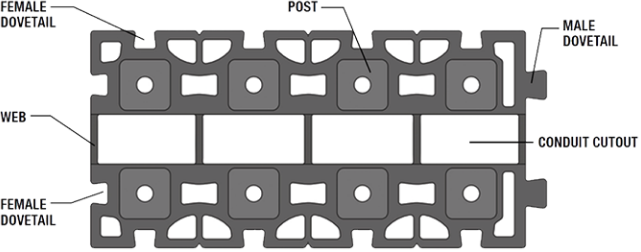
Utility-aware layoutThe plan view shows conduit cutout space and internal channels that should be part of every builder-facing technical explanation.
Recycled-content storyThe Envion material story is rooted in recyclable polypropylene and reduced jobsite waste from whole-block construction.
Application breadthThe old site positioned the system across homes, commercial buildings, apartments, storm shelters, education, medical, military, and disaster relief.
Lok-N-Blok plan view showing conduit cutout, web, posts, and dovetail profiles
Plan view The strongest single drawing for explaining channels, web, posts, male dovetails, and female dovetails.
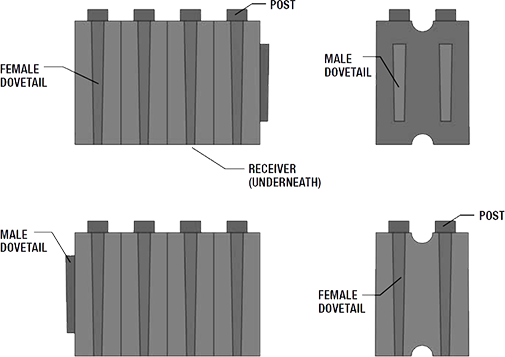
Lok-N-Blok elevation view showing side and end profiles
Elevation views The wall profile is visible from side and end elevations, which helps plan reviewers understand the component.

AI & Robotics Powered

We're not just a building materials company. We're a construction technology platform leveraging AI and robotics to revolutionize every step.

Robotic Assembly

Proprietary robotic systems stack and connect blocks with precision, enabling automated wall construction at unprecedented speed.

AI Home Design

Machine learning optimizes floor plans, material usage, and structural integrity. Design your dream home with AI-assisted customization.

Smart Home Integration

Built-in conduit channels for IoT sensors, automated lighting, climate control, and security systems within the block walls.

Predictive Manufacturing

AI-driven demand forecasting and production scheduling ensures optimal inventory levels and minimizes waste across the supply chain.

Daily Living AI

Post-construction AI assists homeowners with energy optimization, maintenance scheduling, and smart automation for everyday tasks.

Robotic Assembly
AI Design Engine
Smart Sensors

The Future Is Automated

Our vision: robotic assembly lines that stack Lok-N-Blok walls with precision, speed, and zero waste.

We Still Build Homes the Way We Did in 1832

Stick-framing was invented in Chicago in 1832 — two hundred years ago. Every other industry has reinvented itself three times since. 93% of American homes are still built the same way. That ends here.

200yrs

Same Method

Balloon framing was introduced in 1832. Platform framing replaced it in the 1940s, but the fundamental concept — dimensional lumber nailed together on-site by hand — hasn't changed in nearly two centuries.

Source: NAHB / Chicago Public Library
0.4%

Annual Productivity Growth

Construction productivity has grown only 0.4% annually since 2000, compared to 3% for manufacturing. It's effectively the same as 80 years ago. At this pace, the industry will fall $40 trillion short of demand by 2040.

Source: McKinsey Global Institute, 2024
75%

Can't Afford a New Home

Nearly 75% of American households are priced out of a median new home ($416,900). The price-to-income ratio hit 5x — up from 3.5x in 1985. Home prices rose 48% from 2019-2024 while incomes rose only 22%.

Source: NAHB / Harvard JCHS, 2025
$1.4T

Decade of Disaster Losses

Natural disasters destroyed $1.4 trillion in property from 2015-2024. Average annual costs quadrupled from $22B/year in the 1980s to $149B/year today. Home insurance premiums surged 30-40% in 5 years.

Source: NOAA / Climate Central
600M tons

Wasted Every Year

The US generates 600+ million tons of construction waste annually — 23% of the entire national waste stream. Over 75% of wood, drywall, and shingle waste goes straight to landfills.

Source: EPA, 2023
501K

Workers Short Every Year

The construction industry needs 500,000+ additional workers annually. 94% of firms report difficulty filling positions. 54% of contractors face project delays due to labor shortages.

Source: ABC / NAHB, 2024

The question isn't whether construction needs to change.

It's why it took this long for someone to do it.

Build Green. Save the Planet.

Construction produces 39% of global CO2 emissions — and that footprint is projected to double by 2050. Lok-N-Blok is 100% recyclable polypropylene with zero concrete, zero mortar, zero waste.

Zero Concrete. Zero Water Waste.

Concrete production is the 3rd largest source of CO₂ emissions and consumes 10% of the world's industrial water. Lok-N-Blok eliminates both.

8%
of Global CO₂

Cement production alone generates 8% of all global carbon emissions — more than aviation and shipping combined.

Source: Chatham House, 2024
3T
Gallons of Water

The concrete industry uses nearly 3 trillion gallons of water annually — 10% of global industrial water consumption. Drought-stricken regions can't afford this.

Source: World Wildlife Fund
0
Lok-N-Blok Impact

Zero concrete. Zero mortar. Zero water in the build process. 100% recyclable polypropylene blocks that can be disassembled and reused indefinitely.

Patented Technology

No Curing Time

Concrete needs 28+ days to cure. Lok-N-Blok walls are load-bearing immediately upon assembly.

No Heavy Equipment

Concrete requires mixers, pumps, and cranes. Our blocks weigh under 10 lbs each — carried by hand.

Weather Independent

Concrete can't be poured in freezing or extreme heat. Lok-N-Blok assembles in any climate, any season.

$1.4 Trillion Lost. Never Again.

The US lost $1.4 trillion to natural disasters in the last decade. Average annual costs quadrupled since the 1980s. Lok-N-Blok homes survive what destroys traditional construction.

Eliminating the #1 Construction Cost

Skilled labor accounts for 40-60% of traditional construction costs. The US faces a 501,000 worker shortage. Lok-N-Blok eliminates the dependency entirely.

$150K+
Average labor cost for a traditional 2,000 sq ft home
Master Carpenter$75-100/hr
Licensed Electrician$65-95/hr
Master Plumber$60-90/hr
HVAC Technician$55-85/hr
General Contractor15-25% of total
8-15 specialized workers × 6-9 months = massive cost
$20K
Average labor cost for a Lok-N-Blok 2,000 sq ft home
No carpenters needed$0
Snap-in wiring channelsDIY friendly
Pre-formed plumbing routesDIY friendly
2-3 unskilled workers3 weeks
No GC overhead$0
SAVE $130K+ ON LABOR ALONE

501,000 worker shortage in the US construction industry (Source: Associated Builders & Contractors, 2024). Mortarless interlocking systems are designed to lower the skilled-labor threshold of residential framing — a meaningful advantage in markets where qualified crews are scarce or expensive.